research
I am interested in understanding how epithelial cell identity is established, maintained and remodelled during tissue homeostasis, regeneration and tumour initiation. My work combines single-cell and spatial multi-omics, chromatin profiling, gene regulatory network inference, lineage tracing and computational modelling of cell-cell communication to study how epithelial cells respond to oncogenic mutations and microenvironmental cues. By focusing on mammary gland and skin epithelial systems, I investigate how genetically altered cells acquire plasticity, competitive fitness and tumour-initiating potential within otherwise normal tissues. Through this work, I aim to identify the regulatory and spatial principles that control epithelial plasticity, field cancerization, clonal expansion and the earliest steps of cancer development.
Spatial Cancer Genomics and Cell Competition

I am interested in understanding how genetically altered epithelial clones acquire competitive fitness during the earliest stages of tumour initiation. Focusing on cutaneous squamous cell carcinoma, this project investigates how oncogene- or tumour suppressor-targeted epidermal cells expand within otherwise normal skin and interact with neighbouring wild-type cells. By integrating single-cell multiomics, spatial transcriptomics, gene regulatory network inference and cell-cell communication modelling, I aim to define the transcriptional and regulatory programs that distinguish competitive winner and loser cell states. This work also examines how clone topology, epithelial neighbourhoods, stromal and immune microenvironments, and sex-dependent systemic cues shape clonal expansion and early tumour development.
Epithelial Plasticity and Early Breast Tumorigenesis
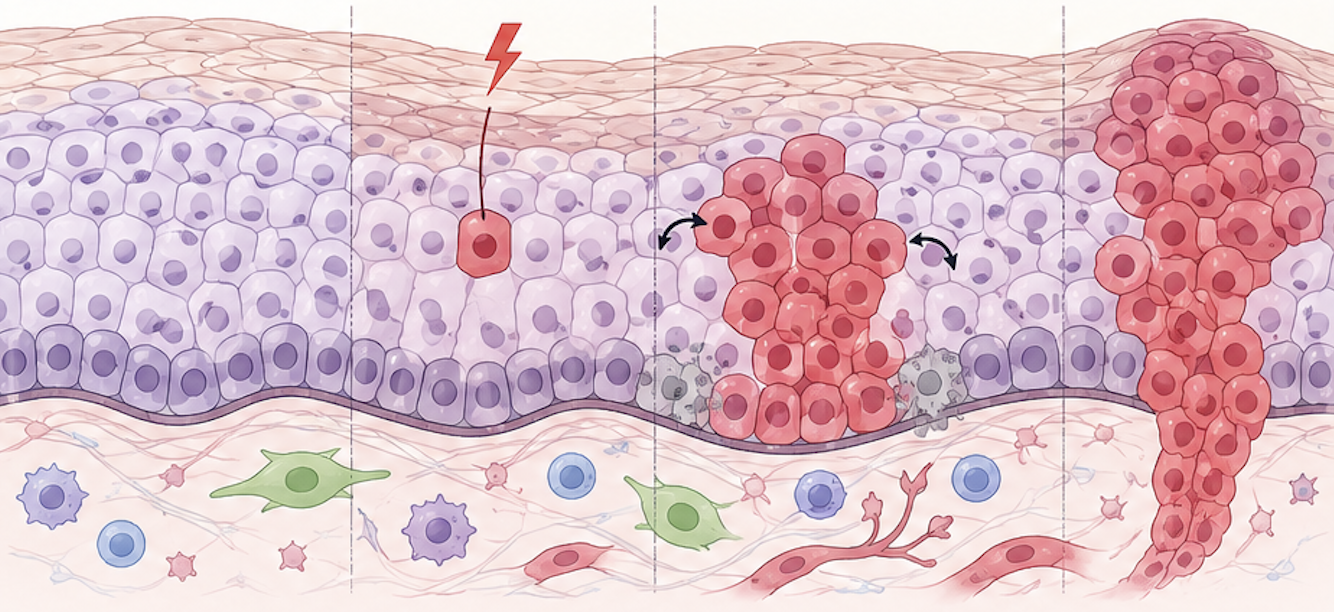
I am interested in how oncogenic mutations alter epithelial cell identity and promote the earliest stages of breast cancer development. Using lineage tracing, intravital imaging, single-cell transcriptomics, chromatin profiling, and gene regulatory network inference, I study how distinct mammary epithelial populations respond to oncogenic insults and acquire competitive advantages within normal tissue. This work focuses on field cancerization, lineage plasticity, and cell-state reprogramming, aiming to understand how genetically altered cells expand, interact with neighbouring wild-type cells, and initiate tumour formation. By integrating clonal dynamics with multi-omics analyses, my goal is to identify the molecular mechanisms that govern epithelial plasticity and determine how the cell of origin influences tumour heterogeneity and disease progression.